Last week a Tennessee judge refused an injunction request to keep the Tennessee Virtual Academy (TNVA) open, and just today the State Legislature appeared to close the door on TNVA when a last-ditch effort to keep it open was refuted.
I have written about this ongoing issue extensively here in my blog so I will not repeat all of it here. However, what will be interesting to watch over the next few years is, if TNVA is actually forced to close, will it be the beginning of a ripple effect across the country for virtual schools, particularly those operated by K12?
Make no mistake, the legal battle in Tennessee is only now just beginning so this is far from over. But, the signs are pointing to TNVA having to close at the end of this school year, and if that is the case, what other states are watching?
Massachusetts? California? Pennsylvania? Ohio? Colorado?
It's a shame really. Virtual schooling can be a revolutionary concept, if done properly. And, situations like this give it a black eye.
houston@figment-consulting.com
Tuesday, April 21, 2015

What is Aspirationgraphics? (from my Virtual School Manifesto)
A while ago I published Virtual School Manifesto: Nine Essential Ingredients to lay out my vision that would allow virtual schools to fulfill their promise. One of those ingredients included a term I coined called Aspirationgraphics -- an idea I covered in depth at a recent conference.
Our friend Webster defines aspiration as a "hope or ambition of achieving something." For me the key word there is ambition.
Virtual schools market themselves as tuition-free yet fail to mention the investment required by the students and the parents.
Virtual schools focus too much on where the students come from instead of their willingness to put in the effort required to get where they want to go. This is where Aspirationgraphics comes in.
Aspirationgraphics focuses on the ambition of the student and the parent and requires virtual schools to be more authentic and transparent.
It works when virtual schools are more concerned about how many students are with them at the end of the school year instead of the count date at the beginning.
houston@figment-consulting.com
Our friend Webster defines aspiration as a "hope or ambition of achieving something." For me the key word there is ambition.
Virtual schools market themselves as tuition-free yet fail to mention the investment required by the students and the parents.
Virtual schools focus too much on where the students come from instead of their willingness to put in the effort required to get where they want to go. This is where Aspirationgraphics comes in.
Aspirationgraphics focuses on the ambition of the student and the parent and requires virtual schools to be more authentic and transparent.
It works when virtual schools are more concerned about how many students are with them at the end of the school year instead of the count date at the beginning.
houston@figment-consulting.com
Thursday, April 16, 2015
3 Free Ways to Improve Customer Service
1. Smile.
Don't just grin but smile.
2. Give the customer your full attention when you utter the words, "Can I help you?"
Stop writing. Stop putting paper away. Stop whatever it is you are doing that takes your attention away from the customer standing in front of you.
3. Convey excitement in your voice.
"Can I help you?" can take on so many different connotations depending upon how you say it. Say it with enthusiasm and you can set the tone for the customer interaction.
houston@figment-consulting.com
Don't just grin but smile.
2. Give the customer your full attention when you utter the words, "Can I help you?"
Stop writing. Stop putting paper away. Stop whatever it is you are doing that takes your attention away from the customer standing in front of you.
3. Convey excitement in your voice.
"Can I help you?" can take on so many different connotations depending upon how you say it. Say it with enthusiasm and you can set the tone for the customer interaction.
houston@figment-consulting.com
Friday, April 10, 2015
Just do it, differently.
 Things don't have to be done the way they have always been done.
Status quo can sometimes be your worst enemy.
"The way we used to do it . . ." can impede innovation.
Little goals produce little results.
If it is not uncomfortable then real change may not occur.
Risk is not a four-letter word to be avoided.
"Yes, if . . ." is better than "No, because . . ." when it comes to innovation.
Don't be the change you wish to see in the world, be the difference maker.
houston@figment-consulting.com
Tuesday, April 7, 2015
Duke wins - did controversial call at the end of the game help?
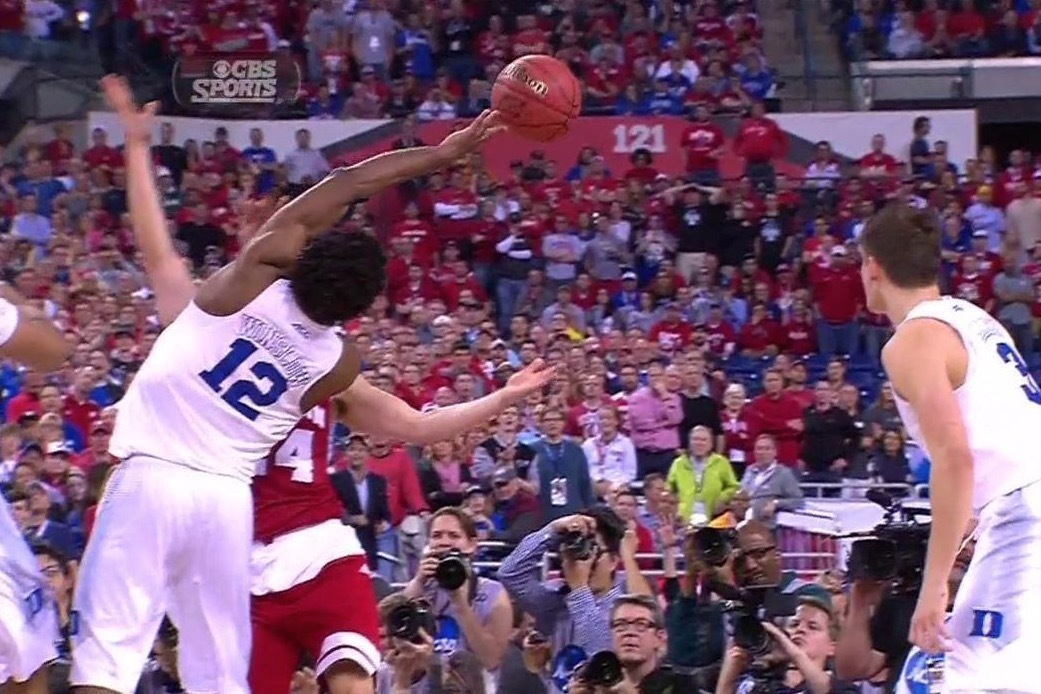
At the end of the NCAA Championship game last night Duke was up by five when underneath the Wisconsin basket there was a loose ball that went out of bounds. The officials first called it Duke's ball but went to the reply to confirm.
CBS showed multiple angles of it and, according to the announcers, it clearly showed that the ball actually went off of a Duke player (unless you live in Durham probably) -- I saw it the same way. So it came as quite a shock when the officials refused to overturn the call even though they saw the same replay angles.
And their explanation is what most intrigues me. Whether or not it played a hand in Duke's victory is not a concern to me though Duke did go down and hit a 3-pt shot to extend the lead on the next play.
Anyway, evidently the referees told CBS that it was not reversed because "they just couldn't see anything."
That amazes me. What exactly could they not see? It was so obvious from several angles that it went off of the Duke player and should have been Wisconsin's ball. How could they not see it? It was so clear, so easy to see.
As I pondered it this morning and how it relates to this blog I write, it caused me to wonder how much I miss, or we miss, that is right in front of us, and so easy to see? When we are presented with the data, or the facts, are there areas where we fail to reverse course because "we just couldn't see anything?" -- where we avoid the obvious because it means we have to admit we are wrong?
houston@figment-consulting.com
Friday, April 3, 2015
The organic chaos of life

Do you find yourself where you believed you would be at this point in your life?
Has your life moved in linearity from one point to another as you had planned?
The answer to each question, for most of us, is no.
Life is much more organic than it is planned. Unexpected doors open up for us and we pursue them. Opportunities present themselves and we follow them as they lead us down paths unknown. Events occur that cause us to reconsider and move in another direction. Emerging technology alters the very course of our lives by creating new while making the old obsolete, and we must adapt.
Life is more of an organic chaos than it is neat and tidy. The struggle for most of us comes when we try to take life and make it linear or structured instead of embracing the chaos.
Perhaps life is not meant to be controlled or managed. Perhaps it is simply meant to be lived.
houston@figment-consulting.com
Wednesday, April 1, 2015
Are you afraid?
For most of us our perceptions frame our reality. We then seek out those who agree with our reality so we can reassure ourselves.
Too few of us take the time to consider opposing views. Adopt some of them -- hardly. We find that problematic, even dangerous. Wait though, before we travel that road laced with fear, what if we simply read some views that were contrary to our own? Consider simply means to think carefully about. What if we gave careful thought to an opposing view?
Could a workweek be condensed to 4 hours? Could marketing be based on permission instead of interruptions? Could we be measuring creativity and intelligence the wrong way?
The challenge is to find a book or video that provides a viewpoint opposite to our own and then read or watch it without condemning it. Simply consider it.
houston@figment-consulting.com
Too few of us take the time to consider opposing views. Adopt some of them -- hardly. We find that problematic, even dangerous. Wait though, before we travel that road laced with fear, what if we simply read some views that were contrary to our own? Consider simply means to think carefully about. What if we gave careful thought to an opposing view?
Could a workweek be condensed to 4 hours? Could marketing be based on permission instead of interruptions? Could we be measuring creativity and intelligence the wrong way?
The challenge is to find a book or video that provides a viewpoint opposite to our own and then read or watch it without condemning it. Simply consider it.
houston@figment-consulting.com
Subscribe to:
Posts (Atom)